
Zhejiang's intelligent bionic robots continue to expand overseas markets, accounting for 60% of the country's total (see chart)
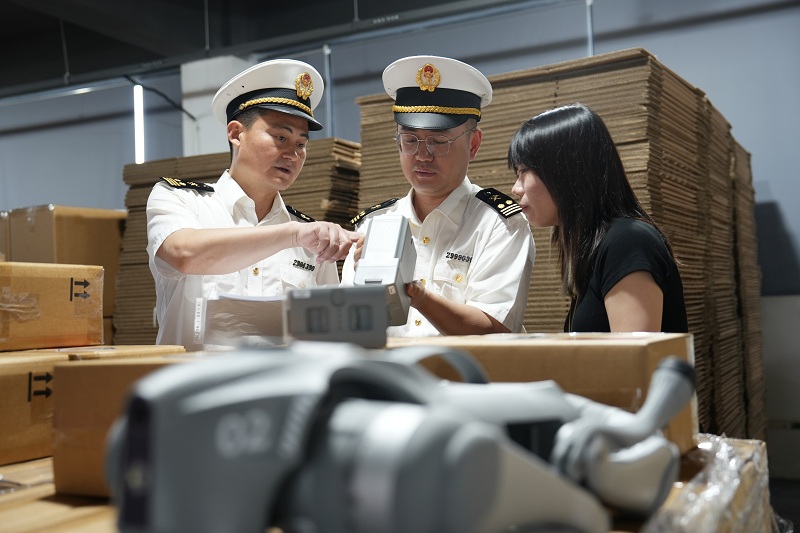
The picture shows customs officers conducting on-site supervision of quadruped robots and their supporting lithium batteries preparing for export. Photo by Xie Yunyan
As a leading province in the national digital economy and future industries, Zhejiang Province has listed intelligent biomimetic and embodied intelligence as the core track for cultivating new quality productivity, built a comprehensive collaborative industrial layout, gathered a group of robot related enterprises, and formed a complete industrial chain of "algorithm core components complete machine research and development global scene landing". According to statistics from Hangzhou Customs, in the first half of the year, Zhejiang Province exported intelligent bionic robots worth over 400 million yuan, accounting for about 60% of the total export value of similar products in the country.
On July 20th, the quadruped robot independently developed and produced by Hangzhou Yunshen Technology Co., Ltd. completed customs clearance and was successfully exported to the Southeast Asian market. It will be used for local factory security patrols, underground pipeline inspections, and other business scenarios.
Cloud Deep Technology was established in 2017, focusing on the research and development, production, sales, and service of quadruped robots, humanoid robots, and core components. Recently, our quadruped robot has officially started working at the largest nuclear power plant in Switzerland, responsible for high-frequency and normalized autonomous inspections of high-risk areas inside the plant, "said Yao Hengyan, Assistant General Manager of Yunshen Technology Co., Ltd. This quadruped robot working at a nuclear power plant can climb 45 ° slopes, flexibly shuttle through equipment gaps, and penetrate areas that are difficult to reach manually. It can also accurately capture subtle hidden dangers such as leakage, temperature anomalies, and equipment noise through the equipped thermal imaging and acoustic sensors. The data is uploaded to the digital control platform in real time, and automatic warning and disposal of anomalies are detected, forming an operation and maintenance closed loop and greatly reducing personnel operation risks.
At present, quadruped robots have achieved global multi-point landing. According to international transportation regulations, the lithium battery used in conjunction with intelligent bionic robots belongs to Class 9 dangerous goods and has strict requirements for transportation, packaging, and identification compliance. In response to the needs of enterprises for exporting complete sets of "one machine, multiple batteries" and shipping spare batteries separately, Hangzhou Customs has launched "one-on-one" policy guidance to guide enterprises in identifying various risks in packaging, declaration, and transportation in advance. Promote the use of electronic identification certificates for the transportation and packaging of dangerous goods for export. Enterprises can submit materials online, view progress in real-time, and download electronic dangerous goods certificates themselves, achieving "zero errand" and significantly reducing the time required for certificate processing.
According to the "2026 Tariff Adjustment Plan" released by the State Council Tariff Commission, a new domestic subheading for "Intelligent Bionic Robots" will be added from January 1st this year. Since then, quadruped robots and humanoid robots have independent tax codes, providing standardized classification system guarantees for the large-scale export of such industries and enhancing international competitiveness.
To help domestic intelligent bionic robots accelerate their overseas expansion, Hangzhou Customs has launched a package of assistance measures. Based on the international market equipment access and environmental certification rules, relying on the "Red Boat Enterprise Navigation" service platform to assist enterprises in accurately pushing overseas access standards to robot production enterprises, and conducting policy lectures; Promote the convenience measures of "online application and self-service printing" for certificates of origin, help enterprises fully enjoy tax incentives under free trade agreements, and further enhance the price competitiveness of domestically produced intelligent bionic robots; In response to the characteristics of small and multiple batches of robot export orders, combined with the enterprise's shipping plan, flexible arrangements for on-site inspections are made to quickly release qualified goods and reduce the cost of short haul warehousing for enterprises. (Zhang Quanping/Text)