
Imported live swimming crabs' fresh 'quickly arrive in Shandong (picture)
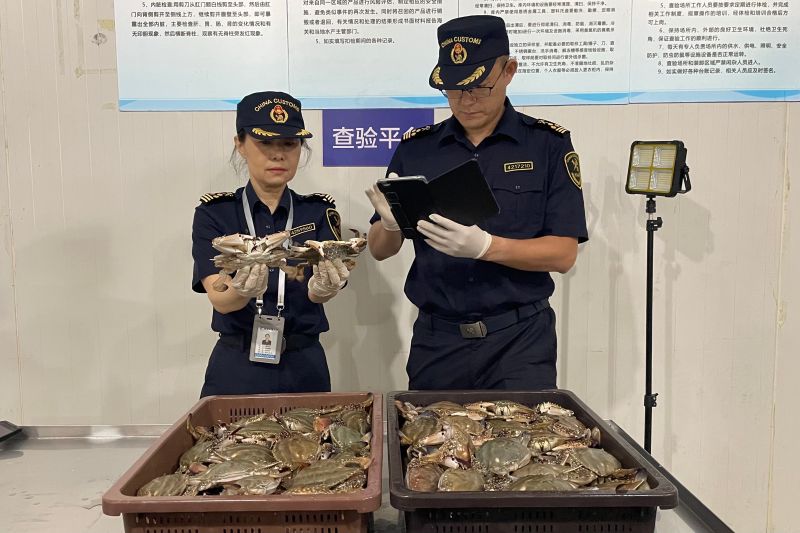
The picture shows customs officers inspecting imported live swimming crabs by Jia Qianqian
On the afternoon of June 5th, a flight carrying 520 kilograms of live swimming crabs arrived at Yantai Penglai International Airport from Incheon, South Korea, and quickly completed customs clearance procedures before leaving the airport.
Previously, live swimming crabs and snail seafood were imported as ordinary goods, which took 1 to 2 days, high losses, and poor vitality. Wang Xianchu, the head of the air transportation department of China COSCO Shipping Central China Co., Ltd. Weihai Branch, introduced that by importing these fresh seafood products through the "air transportation+designated supervision site fast customs clearance" mode, it only takes 12 hours from the nearby Korean fishing grounds to the domestic dining table, maximizing the freshness and taste.
Fresh products have a short shelf life and high customs clearance requirements. Yantai Customs, a subsidiary of Qingdao Customs, has launched a series of convenient measures. We continuously optimize our regulatory mode, make every effort to shorten the clearance time, and ensure that fresh products enter the domestic market in a hurry, "said Liu Yonghui, Deputy Director of the Yantai Customs Office at the airport. The customs has opened a fast track for fresh air cargo, implemented measures such as early declaration, conditional departure, and batch inspection, provided full-time appointment clearance and inspection services, and achieved" immediate inspection upon arrival ". At the same time, through the smart visa system, online visa processing can be achieved to minimize the duration of goods staying at the port.
Since the beginning of this year, Yantai Airport Port has imported a total of 6.5 tons of Korean made live swimming crabs. Liu Yonghui also stated that in the next step, the customs will continue to optimize regulatory service measures, strengthen coordination with airports and ports, use intelligent regulatory equipment and information platforms, achieve seamless connection of goods in transportation, warehousing, inspection and other links, and help accelerate the import of fresh goods. (Xiao Jingjing, Zhang Huan/text)