
Ankang's characteristic hemp rope woven basket achieves export "weaving" and creates attractive "baskets" to live in the big market
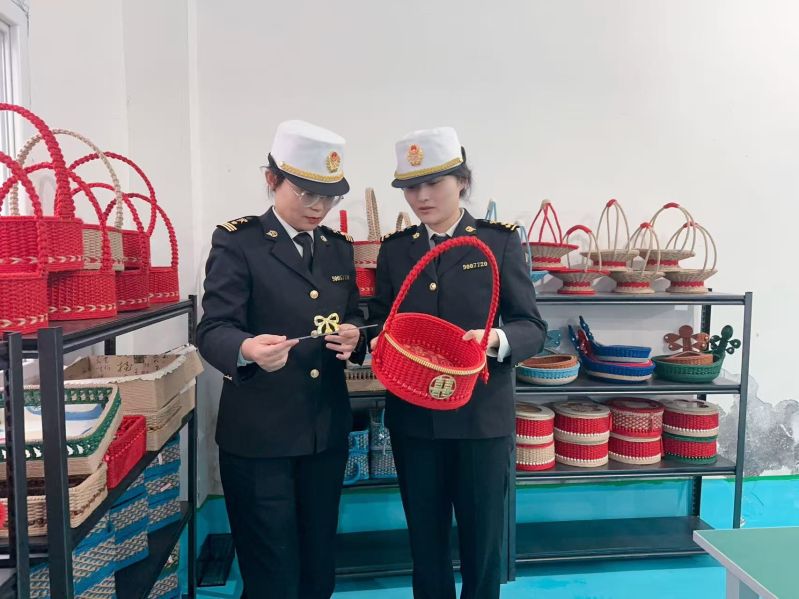
Recently, a batch of exquisite hemp rope woven baskets produced in Ankang City, Shaanxi Province were sent to Malaysia after passing inspection and quarantine by Hanzhong Customs under Xi'an Customs. This is the first time that Shaanxi has exported hemp rope woven baskets, and this handmade woven product with local characteristics from Ankang has successfully entered the overseas market.
Ankang is located in the Qinba Mountain area, where hemp rope woven baskets are a traditional handicraft that combines practicality and artistry. However, for a long time, this type of product has been produced in a family workshop style, sold in local markets or circulated on a small scale through tourism channels, with low industrialization and weak brand effects. With the deepening of green and environmental protection concepts, coupled with the increasing aesthetic demand for handicrafts, hemp rope woven baskets made of natural materials, pure handmade weaving, and incorporating Eastern aesthetic concepts are gradually showing unique appeal in the home decoration and personalized storage market.
Instead of competing in the domestic red ocean, it's better to use the unique cultural genes of our products and seek like-minded people in the international blue ocean, "said Li Feng, the head of Ankang Huamao Tiancheng Trading Co., Ltd., with the original intention of exploring overseas markets. However, from ideas to orders, the "small workshop" that first encountered foreign trade knew nothing about export quarantine requirements, international packaging standards, and customs clearance processes.
Upon learning that the enterprise intends to expand into the international market, Hanzhong Customs immediately initiated key assistance work. The customs found that the most difficult problem faced by enterprises is not production capacity, but how to ensure that products meet the plant quarantine requirements of the export destination country and prevent the spread of pests and diseases with plant materials. In response to this, the customs dispatched personnel to provide on-site guidance, in accordance with relevant Malaysian requirements, to assist enterprises in establishing a full chain epidemic prevention mechanism from raw materials to finished products, setting up quarantine treatment areas, standardizing the processing of hemp rope raw materials and finished product baskets, and recording the process in detail to form traceable "quarantine archives". At the same time, we will explain the customs clearance process for enterprises' foreign trade "blind spots", implement facilitation measures such as "advance declaration" and appointment inspection, embed supervision into the production and shipping process, and achieve "clearance and release upon completion of production". In addition, the customs also provides consultation on international market regulations, guidance on applying for certificates of origin, and encourages enterprises to apply for intellectual property customs protection filing for unique weaving patterns, effectively enhancing product added value and international market recognition.
"Without the close guidance and efficient services of the customs, it is difficult for us to find out the complicated export requirements and successfully deliver goods in such a short time, which gives us great confidence. Next, we plan to further develop more woven products that meet the needs of the international market and expand more markets of countries jointly building the the Belt and Road." Li Feng introduced. The successful export of 1325 hemp rope woven baskets of 14 types not only increased the income of local artisans, but also drove more handmade products with rich cultural characteristics of Qinba region to go abroad.