
Collaborative innovation between customs and ports to facilitate smooth grain import channels (picture)
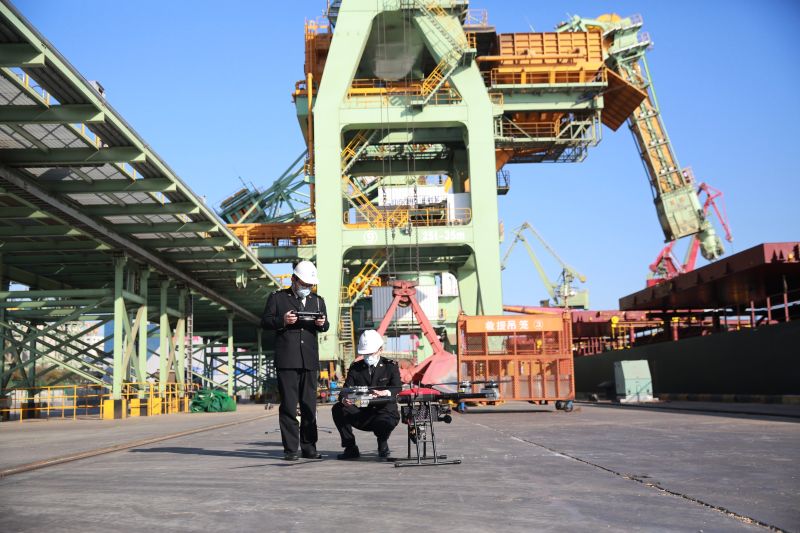
The picture shows customs officers conducting surface quarantine of unmanned aerial vehicles
Shandong Port Rizhao Port is an important grain import hub in China. From a high altitude overlooking the operation site of the port grain terminal, imported grain is continuously shipped from all over the world every day, and then transported to various parts of China and nearby port enterprises through railways and highways.
The Rizhao Customs under Qingdao Customs and Rizhao Port deepen their cooperation and linkage to ensure the smooth and stable supply chain of the grain industry chain.
Recently, at the No. 6 grain dedicated berth in Rizhao Port, a surface quarantine drone was hovering over the imported grain ship. Customs officers carefully observed the situation inside the cabin through a remote control screen on the shore. In less than 2 hours, the surface quarantine work of the entire ship's 7 compartments of soybeans was completed. Then, the domestically produced automated grain continuous unloading machine extended to the cargo ship's cabin, unloading the imported bulk grain into a closed belt conveyor and transporting it to the rear silo.
The expansion of port logistics scale has spurred the reform of customs supervision mode.
In the sampling process, customs supervision has been deeply embedded in the port automation process. By covering 14.5 kilometers of bulk grain conveyors and automated sampling systems for imported grain, customs can complete accurate sampling without contact, and the operation process has zero interference with logistics.
In the transportation process, customs and enterprises jointly explore multimodal logistics transportation such as the conversion of bulk to bulk and rail transportation. The railway port clearance method has gradually shifted from traditional open top cars to various transportation modes such as open top containers, bulk grain special vehicles, and containers. This not only reduces the leakage of imported grain, but also enables efficient unloading and rapid port clearance.
The core of the supervision of imported grain transportation is to prevent the invasion of harmful foreign organisms, ensure national food security, regulate the order of grain circulation, and implement relevant laws, regulations, and quarantine and epidemic prevention requirements.
Rizhao Customs uses "Internet of Things+satellite navigation+cloud computing" technology to build an "in transit supervision system" for imported grain, which realizes "cloud based" full process locking and abnormal warning for transportation vehicles from ports to processing enterprises, forming a closed-loop supervision chain covering all relevant enterprises.
The efficient supervision and high-quality service of customs resonate with the rapid development of ports. The continuous increase in grain imports has led to a gradual shortage of storage capacity, becoming a bottleneck restricting development. In response, the customs promptly intervened and provided guidance, assisting the port in building a 150000 ton grain berth and a silo cluster with a capacity of over one million tons, achieving a qualitative leap in grain storage capacity.
Recently, the renovation and expansion project of the designated supervision site for imported grain at Jurong Port in Rizhao Port has successfully passed customs inspection, adding 43 silos with a total storage capacity of 496000 tons and one dedicated berth to Rizhao Port. At present, Rizhao Port has four specialized process terminals, supporting a storage capacity of 1.3 million tons, forming a grain throughput capacity of tens of millions of tons, injecting strong impetus into the construction of a regional grain trade hub for Rizhao Port.
During the entire process of renovation and expansion, the customs helped us solve many technical problems from site planning to facility debugging, from material declaration to process optimization, which saved us a lot of detours in project construction, "said Liu Baojun, Deputy General Manager of Rizhao Port Jurong Co., Ltd. The upgraded regulatory site is equipped with fully automatic conveying devices and rapid detection equipment, significantly improving the daily grain unloading capacity and achieving an efficient customs clearance mode of" inspection upon arrival at the port and release upon qualification ".
The continuous improvement of supporting facilities for imported grain not only saves intermediate costs such as grain transportation and inversion for enterprises, shortens customs clearance cycles, but also broadens the grain import channels at Rizhao Port, which helps attract more grain trading enterprises to gather and further improve the regional grain and oil industry chain supply chain.
Next, Rizhao Customs will continue to focus on the construction of "smart customs, smart borders, and smart connectivity", deepen cooperation with ports and enterprises, continuously improve the level of intelligent supervision and customs clearance convenience, and take more powerful measures to safeguard national security, smooth grain channels, and help Rizhao build an important grain distribution center in Northeast Asia. (Wang Jingyu, Gu Lijia, Su Maowen/Text)