
Ningbo Customs' 'Robot Dog' Online (Image)
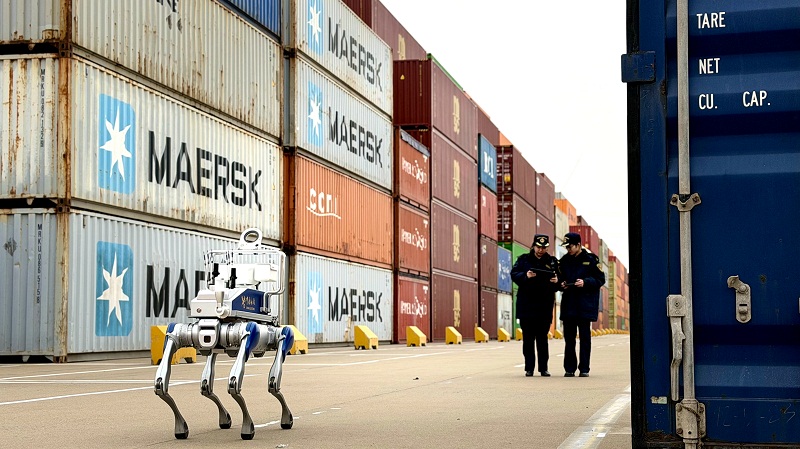
The picture shows customs officers using AI assisted empty container quarantine inspection robots to inspect incoming empty containers. Hong Yun/Photo
At the empty container inspection site in Meishan Port Area, Zhoushan Port, Ningbo, a "robotic dog" is freely shuttling between containers. It sometimes stops to "scrutinize" the box, and sometimes skillfully dives into the box to explore, performing a series of tasks such as automatic inspection, box number recognition, and foreign object recognition. This special 'new customs officer' is the latest AI assisted empty container quarantine and inspection robot put into practical use by Ningbo Customs. Its official "entry" marks a new stage of "AI assisted and intelligent inspection" for the supervision of imported empty containers by Ningbo Customs.
Meishan Port Area has maintained a high-speed development trend in recent years. Data shows that by 2025, the container throughput of Meishan Port Area will exceed 13 million TEUs, of which the imported empty containers for foreign trade will reach 3.858 million TEUs. The business volume continues to grow, and ports and shipping companies are demanding higher efficiency in empty container turnover, putting greater pressure on port supervision.
Relying on the "dual intelligence" construction, Ningbo Customs actively introduces technological strength and has launched an AI quadruped robot that integrates six functions: automatic inspection, container number recognition, interlayer recognition, foreign object recognition, vector recognition, and abnormal warning. It has been put into trial operation at Meishan Customs under Ningbo Customs. It is equipped with optical imaging and thermal imaging dual beam gimbal, multiple industrial grade cameras, high-precision navigation and positioning module, and laser radar, making it a steel guardian equipped with "sharp eyes" and "smart brain". By pre planning the layout of empty container storage and setting the optimal inspection route, the robotic dog can independently complete the inspection site coverage inspection, automatically find and verify the container number, and take photos and send them back, achieving precise positioning and information collection.
With the help of laser measurement and image computing technology, robotic dogs can accurately determine whether containers have compartments. At the same time, they are equipped with fill lights and high-definition cameras to improve their ability to identify vector and harmful organisms. More importantly, robotic dogs can adapt to high-risk and harsh working environments, operate with stable and unified standards 24/7, and effectively improve inspection quality and efficiency, "said Zhang Jian, Deputy Director of the Logistics Monitoring Department of Meishan Customs.
On January 6th, the robotic dog project officially entered the fully quantified trial operation phase. As of January 29th, the robotic dog has assisted in inspecting 1655 natural boxes, with a box number recognition accuracy rate of 92%, a foreign object detection rate of 95%, and a foreign object category recognition rate of 60%. The maximum number of natural boxes inspected in a single day test is 100, and the inspection efficiency is expected to be more than twice that of manual operation mode. (Ge Shuyi/Text)