
The one-year anniversary of the bi-directional connection of the "Qiankai Shanghai" route (pictured)
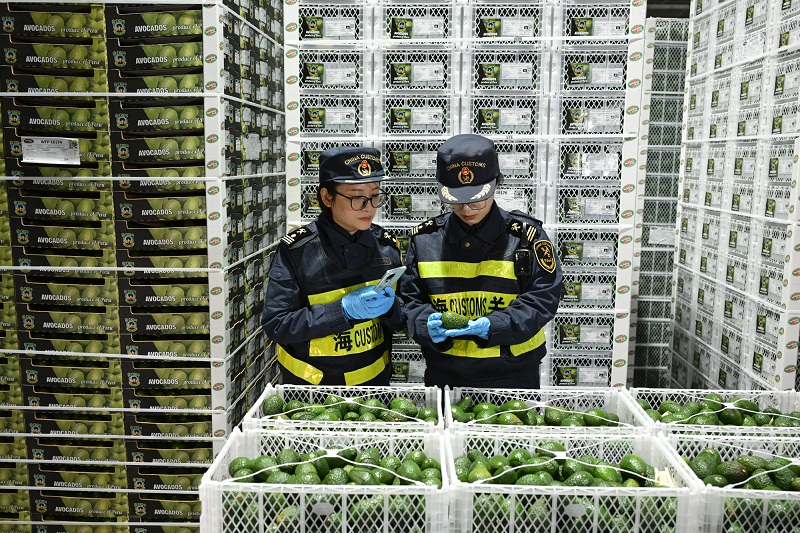
The picture shows: Shanghai Customs imposes supervision on imported avocado from Peru. Shanghai Customs announces/photographed
At 18:30 on December 18th, the "New Shanghai" ship was loaded with fruits such as avocados, blueberries, grapes, and various aquatic products such as squid slices from Peru, and docked at Yangshan Port in Shanghai. On December 18th, one year ago, it was this "New Shanghai" ship that completed its first official voyage from Qiankai Port in Peru to Shanghai. On the previous day, December 17th, another "New Europe" ship had already loaded a large number of exported products such as chemicals, steel, and automobiles, departing from Yangshan Port and heading towards Qiankai Port.
With the vigorous development of the "Qian Kai Shanghai" new era Yala Land Sea corridor, the "two-way rush" between China and Peru and China and Latin America has accelerated, and the development blueprint has become a mutually beneficial and win-win path. According to statistics from Shanghai Customs, the "Qiankai Shanghai" sea freight route has accumulated a total import and export value of 5.57 billion yuan and 205000 tons of goods since its two-way connection on December 18 last year, as of December 18 this year. Driven by this route, Shanghai's foreign trade import and export value to Peru increased by 40.3% in the first 11 months of this year.
For us, the relationship with China is crucial. The opening of the Qian Kai to Shanghai route means that we can export more goods, such as various Peruvian specialty fruits. Due to more efficient and cost-effective trade, the quality of our products is very competitive, and our small and medium-sized enterprises have also ushered in better development opportunities. These favorable factors have brought significant changes
The heavy container throughput between Qiankai Port and Shanghai in the Far East has exceeded 100000 TEUs, which can be said to enrich the cargo exchange between the people of the two places on the Qiankai Port to Shanghai route. "Chen Xiachen, senior business representative of COSCO Shipping's Latin America route department, introduced," In terms of imports, various fruits, grapes, avocados, blueberries, etc. from Peru are the most important commodities. In addition, goods such as fish meal and ore from Peru are also continuously entering China through the Qiankai channel. In terms of exports, our white goods, automobiles, daily necessities and other goods have a broad market in Peru and South America
The reduction in sea freight time is significantly beneficial for fresh goods such as imported fruits. In the first 11 months of this year, the import of Peruvian fruits at Shanghai Port reached 2.58 billion yuan, a year-on-year increase of 117.4%, "said Cui Jinlu, head of the Plant Quarantine Department of Shanghai Customs." We are promoting the construction of smart customs and have developed an intelligent evaluation model for the cold treatment of imported fruits, which allows shipping companies with conditions to automatically push their cold treatment data to the customs system. This saves inspection time and allows Peruvian fruits to enter the Chinese market in a fresher state
Yu Zhuowen, General Manager of Tonghua Supply Chain Management Group Co., Ltd., introduced, "The new channel from Qiankai to Shanghai has shortened the sea freight time from over a month to about 23 days. As importers, our comprehensive costs have been reduced by about 20%. The public can also enjoy fresher Peruvian fruits. Next, we will import more fresh products and other bulk goods from Latin America to meet the needs of the domestic consumer market
Over the past year, in order to ensure the safe and convenient customs clearance of import and export goods on the "Qian Kai Shanghai" route, Shanghai Customs has accelerated the construction of a smart customs, established a linkage response mechanism with port units, and tailored a "one-stop" service plan for direct flights. (Chen Wei/Text)