
The annual average growth rate of the number of China Europe freight trains (Shenzhen) in operation for the sixth anniversary is nearly 50% (see chart)
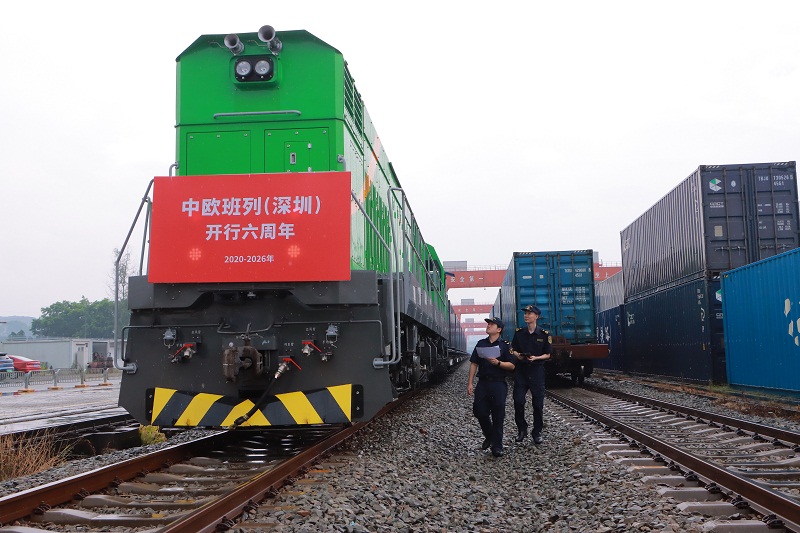
The picture shows customs officers conducting pre departure inspections on the China Europe freight train (Shenzhen), photographed by Li Yanwei
On August 18th, with a long roar, a China Europe freight train (Shenzhen) loaded with 718 tons of goods such as toys and non-woven fabrics departed from the Pinghu South National Logistics Hub. On this day, the China Europe freight train (Shenzhen) celebrated its sixth anniversary of operation.
Over the past six years, the China Europe freight train (Shenzhen) has achieved a leapfrog development from scratch to excellence. Brand routes such as boutique trains and European express lines continue to expand, and the China Kyrgyzstan Uzbekistan corridor, the cross mile maritime transport corridor, and the multimodal transport path from St. Petersburg to Germany have been successively connected. A resilient land trade artery that spans Asia and Europe, advances in multiple directions, has already taken shape. Nowadays, the China Europe freight train (Shenzhen) has established a three-dimensional network with parallel radiation from the four main lines of China Russia, China Europe, Central Asia, and China Laos. It has opened 28 regular operating lines, covering 40 cities in 16 countries, and has become an important link connecting the Guangdong Hong Kong Macao Greater Bay Area with the world.
As a logistics enterprise rooted in the Greater Bay Area, our most intuitive feeling is that the China Europe freight train (Shenzhen) has accelerated in the past six years! "Huang Zebin, the head of product operations for the South China region of Shenzhen Dayang Logistics Co., Ltd., sighed." Especially for manufacturing enterprises such as electronics, home appliances, and mechanical equipment in the Bay Area, this channel is faster and cheaper than sea freight, with controllable delivery times. It has now become our main channel for shipping to Europe and Central Asia
Nowadays, more and more "smart manufacturing" products in the Bay Area are taking this train to go abroad. The categories of goods have gradually expanded from clothing, shoes, hats, daily necessities and other products in the early stage of operation to 8 categories and more than 7000 types of products such as mechanical equipment and automotive parts, with mechanical and electrical products accounting for over 60%.
The smooth operation of trains cannot be separated from the continuous improvement of clearance efficiency. Over the past six years, Shenzhen Customs has collaborated with railway departments and train operators to establish a coordination platform, ensuring the on-time departure and efficient operation of trains throughout the entire process. At the same time, we will open up a "direct train" for customs clearance services, establish a high timeliness green channel for goods inspection, provide "one-on-one" full process declaration guidance and policy guidance, implement the "advance declaration, appointment inspection, and immediate release" mechanism, and achieve 24/7 response and full time service.
We actively expand integrated business models such as' train+cross-border e-commerce 'and' train+bonded ', promote convenient measures such as railway express and manifest consolidation, compress document processing time by nearly 70%, and significantly reduce port detention time. At the same time, we support multimodal transport modes such as railway public transport and cross Caspian sea railway sea transport, helping enterprises flexibly choose transportation routes and continuously improve the overall resilience of the channel. "Lin Hai, from the Inspection Department of Sungang Customs, a subsidiary of Shenzhen Customs, introduced.
As of now, the China Europe freight train (Shenzhen) has shipped a total of 1122 trains, with an average annual growth rate of 49.9% in the number of operations; The export value reached 28.9 billion yuan, and the average value of goods per single train was 33 million yuan. (Liu Hong, Chen Yuting/text)