
The cumulative number of inbound and outbound vehicles at the Zhuhai Highway Port of the Hong Kong Zhuhai Macao Bridge has exceeded 25 million! (Image)
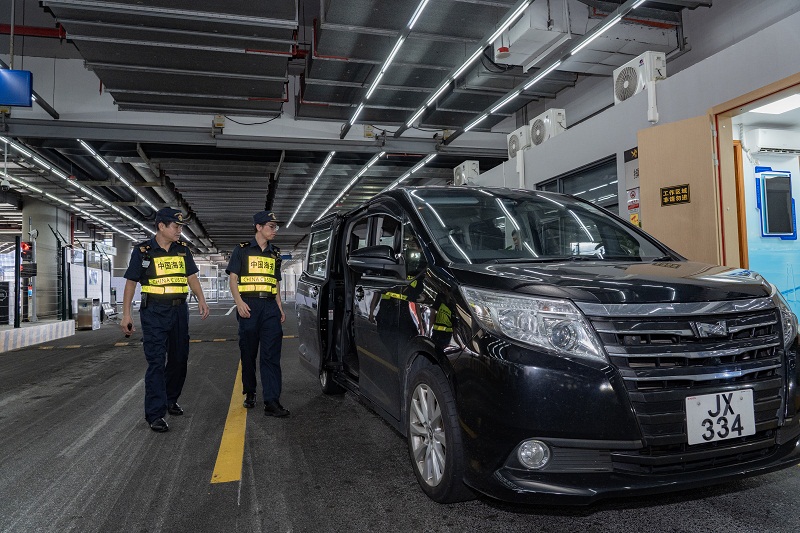
The picture shows Lin Changfeng, a customs officer inspecting and releasing a single license plate vehicle from Hong Kong that goes north
According to statistics from Gongbei Customs, since the opening of the Zhuhai Highway Port on the Hong Kong Zhuhai Macao Bridge, as of August 10th this year, the cumulative number of vehicles entering and exiting through the bridge port has exceeded 25 million, with a peak of 29700 vehicles per day. The two-way traffic flow at the bridge port has maintained a high level for a long time. Since the beginning of this year, the total number of vehicles entering and exiting through Daqiao Port has reached 4.25 million, an increase of 8.4 times compared to the same period in 2019; The number of single license plate vehicles traveling north to Hong Kong and Macau reached 2.48 million, accounting for nearly 60% of the total number of inbound and outbound vehicles at the port. Since the implementation of the policy of two vehicles heading north in 2023, the heat of travel between Guangdong, Hong Kong, and Macao has continued to rise. The Hong Kong Zhuhai Macao Bridge is promoting the integrated development of the Guangdong Hong Kong Macao Greater Bay Area with innovative and convenient momentum.
In the face of the continuous growth of traffic flow and the continuous release of cross-border travel demand, the customs upgraded the security system in an all-round way: strengthened the coordination and linkage of departments, promoted the hardware upgrading and on-site reconstruction of passenger car channels with various port units, and the consortium discussed to predict the peak of traffic flow, deployed on-site manpower in advance, and conducted peak dredging; Multi dimensional embedding of the achievements of the "Smart Customs" construction, equipped with big data analysis and intelligent map review functions, iterative upgrading of the "one-stop" system, constantly upgrading the new experience of "timely supervision" and "seamless customs clearance", fully unleashing the benefits of the "Guangdong car southbound", "Hong Kong car northbound" and "Australian car northbound" policies.
With the implementation of the second batch of "Guangdong cars heading south" policies, the connectivity pattern of the Guangdong Hong Kong Macao Greater Bay Area has reached a new level. Starting from July 25th this year, the "Guangdong Car Southbound" service has officially expanded, allowing private cars from Shenzhen, Foshan, Dongguan, Huizhou, and Zhaoqing in the Guangdong Hong Kong Macao Greater Bay Area to directly reach the city center of Hong Kong through the Daqiao Port. Residents of nine mainland cities in the Greater Bay Area can drive south to Hong Kong for commuting, business, tourism, and family visits... The concept of the "one hour living circle" in the Bay Area has once again broken through and upgraded. After this policy expansion, we can also drive directly to the city center of Hong Kong, with many flexible travel options, especially for family outings. We don't have to shuttle public transportation multiple times, which is really convenient, "said Ms. Chen, a car owner from Shenzhen
As a participant and witness of 'Guangdong vehicles heading south', 'well managed and fast communication' has been our goal that we have been striving for. Since the beginning of this year, the customs have supervised and released more than 21000 vehicles of 'Guangdong vehicles heading south'. "Lin Jin, the head of the Customs Supervision Department of the Hong Kong Zhuhai Macao Bridge, said," We have set up dedicated lanes, iteratively upgraded software and hardware facilities, and provided timely guidance and assistance for drivers who are driving south for the first time. "In the next step, the customs of the Hong Kong Zhuhai Macao Bridge will continue to deepen the construction of smart customs, optimize regulatory services, and help promote the integrated development of the Guangdong Hong Kong Macao Greater Bay Area. (Yang Yueqi/Text)