
Crafted with skillful hands, weaving the 'sea route' (picture)
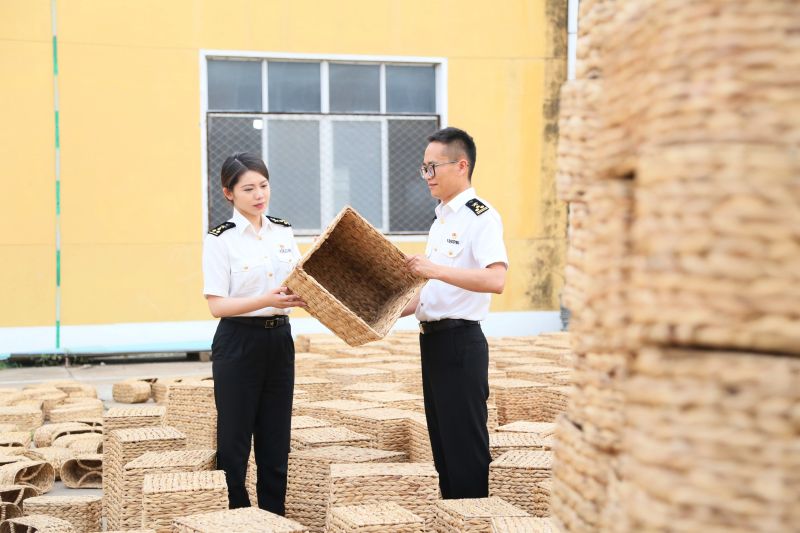
The picture shows customs officers conducting on-site inspection of export woven baskets. Photo by Liang Zhaohui
On August 5th, I walked into the production workshop of Linyi Jinliu Crafts Co., Ltd. located in the old area of Yimeng, Shandong. After precision processing of raw materials and hand weaving, willow branches, straw, and other materials that were originally treated as agricultural waste were transformed into household items and crafts. After quality inspection and customs supervision of the finished products, they can be exported to the international market.
In the hot summer season, bamboo, wood, grass, and willow in the revolutionary old areas of Yimeng are in high demand for raw materials. Relying on the unique advantages of agricultural and forestry resources, local people have processed raw materials such as willow branches, bamboo, and straw into creative and household products, turning traditional "old crafts" into export "good industries" and opening up a path for rural income growth and prosperity.
As a core export production area for bamboo, wood, grass, and willow products, Linyi's grass and willow weaving and bamboo and wood handicrafts are highly distinctive outward oriented industries that enrich the people. Local enterprises are based on traditional handicrafts and integrate modern design concepts to launch diversified products such as home storage, gardening decoration, and cultural and creative crafts. With the characteristics of green environmental protection and natural texture, they have a stable customer base in the international market.
With the continuous upgrading of overseas market access standards, various quarantine and environmental access requirements are becoming increasingly strict, which once put pressure on enterprise exports. Overseas buyers are updating their quarantine standards. If they are unable to adapt to the new regulations, a large number of orders will face the risk of rejection, directly affecting their overseas market layout, "said Qiu Ziyan, the head of the company.
In response to the compliance export difficulties encountered by enterprises, Linyi Customs, a subsidiary of Qingdao Customs, took the initiative to conduct research on enterprises. Based on the characteristics of bamboo, wood, grass, and willow products, and in comparison with import quarantine standards of various countries, special analysis and benchmarking research were carried out. After multiple rounds of technical verification, Linyi Customs has helped enterprises innovate and adopt compliant heat treatment processes to replace traditional treatment methods, while ensuring product quality and fully preserving weaving techniques, to meet the latest overseas quarantine and access requirements.
At the same time, in response to the problem of insufficient knowledge and benefits of free trade agreement policies among small and medium-sized enterprises in the jurisdiction of bamboo, wood, grass, and willow, Linyi Customs has carried out precise policy propaganda, focusing on popularizing preferential policies such as RCEP origin, guiding enterprises step by step to apply for certificates of origin in a standardized manner, enjoying tariff reductions and exemptions, and enhancing the international pricing advantage of products.
The bamboo, wood, grass, and willow industry in Linyi has bid farewell to the extensive production mode and gradually moved towards a new development path of standardized production, standardized quarantine, and branded export. Yao Zhiyuan, the head of the inspection department of Linyi Customs, introduced that currently, there are more than a thousand bamboo, wood, grass, and willow export enterprises in Linyi, with product categories covering hundreds of characteristic products, which are sold well in dozens of countries and regions around the world.
According to statistics, in the first half of this year, the export of bamboo, wood, grass, and willow products in Linyi reached 12.8 billion yuan, a year-on-year increase of 17.4%. (Letter from Jing Yu/Text)