
Yongpai: Intelligent robots' on duty 'empty box inspection enters AI assisted era
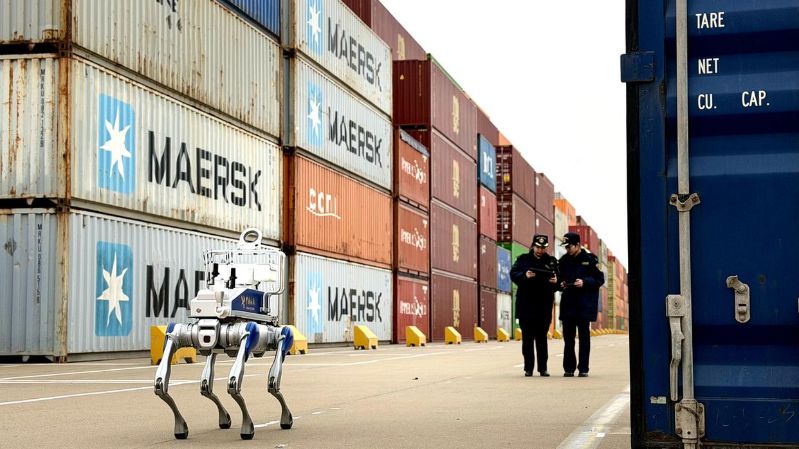
In Meishan Port Area of Zhoushan Port in Ningbo, a flexible quadruped robot is active in the empty container yard. It sometimes stops to "scrutinize" the surface of the container, and sometimes lightly drills into the box to perform inspections - this is the latest AI assisted empty container quarantine inspection robot put into use by Ningbo Customs. Its official "on duty" means that Ningbo Customs has entered a new stage of "AI assisted and intelligent inspection" in the supervision of imported empty containers.
As the fastest-growing single container terminal in Ningbo Zhoushan Port, Meishan Port had a container throughput of over 13 million TEUs last year, and imported empty containers for foreign trade reached 3.858 million TEUs. With the continuous increase in business volume, the traditional manual inspection mode is no longer able to fully meet efficiency requirements. In the traditional mode, a customs officer inspects about 200 containers per day, while the requirements for empty container turnover efficiency from ports and shipping companies continue to increase.
To this end, Ningbo Customs has launched an AI assisted quadruped robot with six core functions, which has been put into trial operation at Meishan Customs. This robot integrates automatic inspection, box number recognition, interlayer recognition, foreign object recognition, vector recognition, and abnormal warning. It is equipped with an optical and thermal imaging dual beam gimbal, multiple sets of industrial grade cameras, and is equipped with a high-precision navigation and positioning module and a laser radar.
Zhang Jian, Deputy Director of Logistics Monitoring Department 2 at Meishan Customs, introduced that the robot has "sharp eyes" and "intelligent brain": by preset yard layout and optimal inspection route, it can independently complete area coverage inspection, automatically search for boxes, verify numbers, take photos and feedback, and achieve precise positioning and information collection. With the help of laser measurement and image computing technology, robots can accurately determine whether there is a sandwich inside the box; At the same time, relying on fill lights and high-definition cameras, its ability to identify vector and harmful organisms has also been significantly improved.
As of March 25th, the robot has assisted in inspecting over 5000 empty boxes, with an accuracy rate of 92% for box number recognition, 95% for foreign object detection, and 60% for foreign object category recognition. After being put into all-weather operation, the overall inspection efficiency has increased by more than twice compared to traditional manual operation.