
Processing trade supports the development of Qingdao champion enterprises (picture)
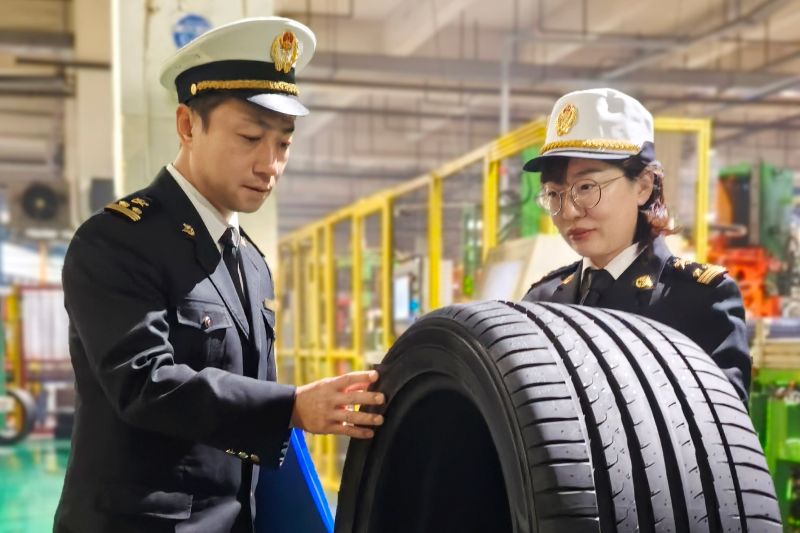
The picture shows customs officers conducting research at tire processing enterprises. Photo by Feng Lei
Processing trade has been widely adopted by foreign trade enterprises in China since the reform and opening up, due to its policy advantages of temporarily suspending taxes on imported goods and exempting taxes on exported finished products. Recently, the list of the ninth batch of national manufacturing industry champions was announced, and seven enterprises in Qingdao were successfully selected, all of which are processing and trade enterprises.
The national level manufacturing industry champion is an important symbol of the core competitiveness of urban manufacturing industry. Cultivating individual champion enterprises requires not only the persistence and innovative breakthroughs of the enterprises themselves, but also the policy support that adapts to the development of the industry.
Recently, in the production workshop of Sailun Group Co., Ltd., the automated assembly line is operating at full capacity, and a batch of 1173 export radial tires are being produced intensively, ready to be sent to overseas markets.
World tires look at China, Chinese tires look at Shandong. Sailun Group Co., Ltd., headquartered in Qingdao, with products covering multiple fields such as passenger cars, commercial vehicles, and special vehicles, is one of the newly added champion enterprises.
For our tire industry, the finer the product categories are divided, the more difficult it is to determine the consumption of materials and labor costs will increase accordingly. In the case of cultivating both domestic and international markets simultaneously, rigid unit consumption standards are also somewhat difficult to adapt to the flexible production needs of enterprises, "said Meng Hailiang, the sales support director of the company.
Unit consumption refers to the quantity of materials consumed by processing trade enterprises in the production of finished products. It is understood that the main raw material for the export tire industry is imported rubber, so it is mostly carried out through processing trade. And unit consumption management is an important basis for customs to verify whether the quantity of imported bonded materials and exported finished products of enterprises is reasonable.
In response to common issues in this industry, Qingdao Customs has implemented the first pilot reform of tire processing trade unit consumption parameter management nationwide, upgrading the original rigid unit consumption standard to a more flexible unit consumption parameter management mode, while optimizing the unit consumption filing and verification mechanism.
After the reform, we can compare the material consumption ratio with the quota parameters in the first time during the development and production of new products, without frequent adjustments to the production line, and significantly reduce management costs. Meng Hailiang highly recognized the effectiveness of the reform.
The sustained release of policy dividends injects strong impetus into the high-quality development of regional industries. According to statistics, the export value of rubber tires in Qingdao will reach 20.974 billion yuan in 2025, a year-on-year increase of 1.3%.
While optimizing unit consumption management to empower traditional industries to improve quality and efficiency, Qingdao Customs is also anchoring the trend of manufacturing cluster development and implementing targeted measures to smooth the synergy of the industrial chain.
Our group has multiple subsidiaries, and in addition to deep processing cooperation between vertical upstream and downstream, there are also a large number of business demands for horizontal material allocation. The demand for raw material allocation between various enterprises is relatively high, "said Zhu Xinning, the customs manager of Qingdao Hisense Video Technology Co., Ltd. As a representative of the transformation of Qingdao's manufacturing industry towards high-end, the company has also been successfully selected for the list of individual champions.
Faced with practical problems such as frequent transfer of bonded materials between different production plants within the group and cumbersome business processing procedures, Qingdao Customs has innovatively launched a corporate group processing and trade supervision model, actively supporting the enterprise to participate as a member unit.
The supervision mode of enterprise group processing trade has enlarged the granularity of supervision, implementing bonded supervision as a whole for enterprise groups, breaking through the restriction that bonded materials and equipment cannot be transferred across enterprises, allowing free distribution and disposal of materials within the group, not only reducing the compliance pressure of enterprises, but also achieving synchronous improvement of customs supervision efficiency, "said Du Kai, Deputy Director of the Enterprise Management Department of Huangdao Customs.
In 2025, Hisense Group has carried out 10 batches of cross factory transfer of bonded materials, involving a total value of 66.142 million yuan. With the new model, customs clearance time and operating costs have been significantly reduced, and the production capacity within the group has been fully utilized, giving us full confidence in competing for orders in the international market. "Zhu Xinning deeply felt this.
In recent years, Qingdao Customs has continued to implement reform measures to promote the sustained high-quality development of processing trade, transforming the results of the reform into dividends for enterprise development. It not only focuses on the development demands of individual enterprises, but also focuses on the overall upgrading of the industrial chain, helping champion enterprises to fully unleash the driving effect. According to statistics, by 2025, the import and export of processing trade in Qingdao will reach 146 billion yuan, a year-on-year increase of 2.8%, and the "magnetic field effect" formed by the combination of policies will continue to emerge.