
Huangdao Customs: Smooth international logistics channel to serve the construction of international shipping hub (picture)
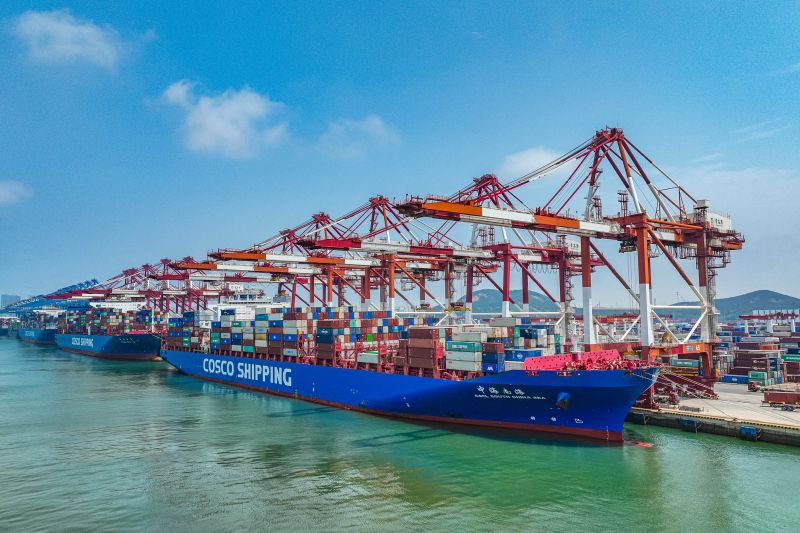
The picture shows an international vessel docking at the container terminal in Qianwan Port Area of Qingdao Port, photographed by Liu Aijun
At dawn, the Qianwan Port Area of Qingdao Port in Shandong Province is bustling with activity. The giant ship docks, the bridge crane swings, and the containers flow like a woven fabric. As an international shipping hub in Northeast Asia, Qingdao Port has achieved a cargo throughput of over 700 million tons and a container volume of over 30 million TEUs for three consecutive years, ranking among the top five ports in the world. Qingdao Port has also ranked first in the business environment evaluation of China's maritime container ports for five consecutive years.
Intelligent transportation ensures smooth shipping flow
Recently, the "Huayuan Baowang" ship, loaded with foreign trade containers, slowly docked at the Qianwan Port Container Terminal of Qingdao Port. Some of the goods carried have been transported through the "Shangangtong" intelligent transfer new mode. After completing customs clearance at Rizhao Port, they will directly board Qingdao Port's ocean going mainline ships and sail to various parts of the world.
Previously, there were customs transfers between Rizhao and Huangdao, but now the system can select it, saving an average of one to two days and saving customers nearly one million yuan in costs annually, "said Ding Ju, the Operations Manager of Rizhao Company at Qingdao Xiangtong Customs Declaration Agency.
To support the acceleration of logistics between ports in Shandong Province, Huangdao Customs under Qingdao Customs continues to deepen the reform of port logistics mode. Based on the successful practice of the "water water intelligent transfer" mode and the "cross port intelligent transfer" platform in the early stage, the "Shan Gang Tong" intelligent transfer mode reform has been implemented.
This model takes Qingdao Qianwan Port Area as the hub and six ports in Shandong Province as branch lines, constructing a 'one port, multiple zones' combined logistics operation mode. The branch ports are regarded as berths of the hub ports, and the transportation of goods between the two ports is regarded as the transfer between different berths in the same port, eliminating the traditional customs declaration process and achieving intelligent transfer and efficient circulation of goods between regional ports. "Ding Xinghua, Deputy Director of the Manifest Management Department of Huangdao Customs Port Supervision Office, introduced.
Since the implementation of the "Shan Gang Tong" model on July 1, 2025, it has covered six branch ports including Weihai, Rizhao, Yantai, and Longkou in Shandong Province within six months, transferring 14000 tickets and 59000 containers, and taking a crucial step towards the integration of the Shandong port cluster.
One code connection speeds up the operation of the port area
Previously, the actual code for ship berthing was inconsistent with the declaration, and companies had to rush to obtain materials, go to customs overnight, delete documents and re declare, which was time-consuming and laborious, "said Lv Guochao, assistant manager of the Shipping Department of Qingdao Port International Logistics Co., Ltd.
After more than 30 years of rapid development, the Qianwan Port Area of Qingdao Port has gradually derived two port codes and two customs district codes. With the acceleration of port integration, there is an increasing number of collaborative operations between different regulatory areas. The lack of unified codes makes it difficult for ports to coordinate and adjust berths, hindering the efficient operation of port operations. The inconsistency between navigation plans and actual berthing also adds a series of burdens to ship agency enterprises.
In order to comply with the trend of integrated port operation and improve the customs clearance experience of import and export enterprises, Huangdao Customs relies on the "District Customs Port Joint Conference" mechanism, leading multiple parties such as Qingdao Port and logistics enterprises to conduct joint debugging and testing. By October 2023, the comprehensive unification of the customs district code (4218) and port code (CNQGD) of Qianwan Port Area will be completed, achieving "one declaration, all Hong Kong passage" in Qianwan Port Area.
After the unification of the code, nearly 20000 inbound and outbound ships per year have bid farewell to code switching operations. Single ships can save 1 to 2 days of deletion and re reporting time, and the utilization rate and operational efficiency of dock berths have been fully improved. It has also brought significant benefits to shipping companies, shippers, and ports, "said Liu Haitao, head of the Supervision Department of Huangdao Customs Port Supervision Office.
As of now, Qingdao Port has nearly 240 air routes, connecting with more than 180 countries and regions and over 700 ports worldwide. Its international shipping hub competitiveness index ranks first in Northeast Asia.
Sea rail intermodal transportation is convenient for inland sea transportation
Recently, a railway special train loaded with car spare parts and microcrystalline glass arrived at Qingdao Port from Zhengzhou Putian Central Station. Through the "land sea linkage, sea rail direct transportation" supervision mode, the system automatically transferred the goods to customs for verification and release upon arrival, and then loaded them onto ships and sent them to overseas markets such as Southeast Asia and Africa.
As the most convenient seaport in the Yellow River Basin, Qingdao Port not only radiates within Shandong Province, but also continues to extend inland. More than half of the exported goods from provinces such as Henan and Shaanxi go out to sea through Qingdao Port.
In order to fully leverage the advantages of land sea interconnection and comprehensive hub functions of Qingdao Port, Huangdao Customs has innovatively launched the "land sea linkage and sea rail direct transportation" model, allowing goods to be automatically transferred through the full process of sea rail intermodal transportation after completing customs clearance and inspection procedures at the inland port, achieving direct transportation by train, direct loading upon arrival, and original container loading on board.
Under this mode, each box of goods can save about 200 yuan in logistics costs and save more than 24 hours of waiting time in port storage. It has been replicated and promoted to 11 inland ports such as Xi'an, Zhengzhou, and Jinan. "Zhang Lin, Deputy Director of the Port Supervision Department of Huangdao Customs, introduced that on this basis, the customs also innovates the" SCO Express "mode, promotes the extension of terminal functions to SCO hub ports, realizes the linkage of" train+port ", and accelerates the construction of a" hub to hub "main and branch connection network.
Data shows that by 2025, the combined sea rail transportation volume of Qingdao Port will reach 2.829 million TEUs, a year-on-year increase of 11%, ranking first in the country for eleven consecutive years. As of now, Qingdao Port has built 55 inland ports and opened 86 sea rail intermodal trains. (Yin Spring, Hui Xiaomeng/Text)