
Yongpai: Electric vehicle sales are expected to account for nearly 30% of global new car sales by 2026
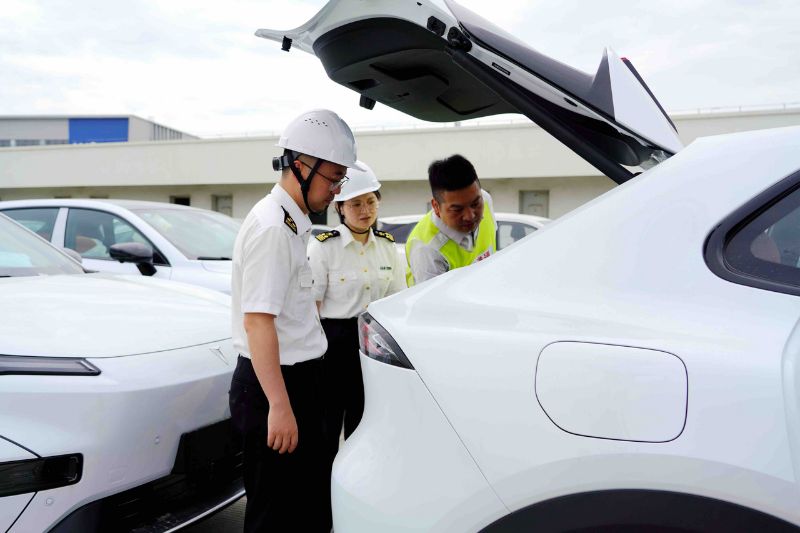
Ningbo Customs officers conduct on-site supervision on cars that are about to be packed for export. Correspondent Zhu Jiana/Photo
Yongpai Comprehensive
The latest Global Electric Vehicle Outlook 2026 report released by the International Energy Agency predicts that global electric vehicle sales will reach 23 million units by 2026, accounting for nearly 30% of global new car sales, compared to only about 5% five or six years ago. Among them, the expected sales growth rate of electric vehicles in the European market is 20%; Electric vehicle sales in countries in the Asia Pacific region, excluding China, are expected to increase by over 50%; Sales in Latin America are expected to increase by 45%. The Director General of the International Energy Agency, Fatih Birol, recently stated that the global electric vehicle market has entered a new stage of accelerated growth.
Sales in multiple countries break historical records
Since the beginning of this year, with the rise in international oil prices, consumers' willingness to purchase electric vehicles has significantly increased. In addition, with the promotion of relevant support policies in various countries, the global electric vehicle market has accelerated its expansion. According to the latest data from Benchmark Mineral Intelligence, a globally renowned consulting firm based in London, the registered number of pure electric vehicles and plug-in hybrid vehicles worldwide was approximately 1.8 million in May 2026, a year-on-year increase of 3%, achieving three consecutive months of growth.
The latest report from S&P Global Mobility shows that in March and April of this year, 91% of countries and regions worldwide had higher sales of electric vehicles than the same period last year, with a total of 37 countries and regions achieving a historic high in monthly electric vehicle sales. Among them, 28 countries and regions including Australia and the UK broke the monthly sales record for electric vehicles in March, while 9 countries and regions including Brazil set a new high for electric vehicle sales in April. The proportion of electric vehicles in 28 countries and regions has exceeded the threshold of 16%, which is often regarded as an important milestone for the expansion and popularization of electric vehicles in the industry. From a regional perspective, in the first quarter of 2026, the sales of electric vehicles in Europe increased by nearly 30% year-on-year, while countries in the Asia Pacific region, excluding China, increased by 80% year-on-year, and sales in Latin America increased by 75%.
Charles Lester, the data manager of Benchmark Mineral Intelligence, said that since the beginning of this year, subsidy policies and sustained high fuel prices have stimulated consumer demand for car purchases, and many users have chosen to purchase electric vehicles in advance. The car sales data reflects a significant shift in consumer behavior, with strong demand for electric vehicles in some regions and rapid depletion of existing inventory. The Global Electric Vehicle Outlook 2026 report predicts that with the increasing competitiveness of electric vehicles and stricter carbon dioxide and fuel efficiency standards, the global number of electric vehicles will reach 510 million by 2035, an increase of more than six times compared to 2025, and the share of electric vehicles in global car sales will increase to about 50%.
Deepening the electrification of transportation
The International Energy Agency report believes that the measures taken globally to address the energy crisis will reshape the global automotive market landscape in the coming years. Data shows that by 2025, the global stock of electric vehicles could reduce the daily demand for oil consumption by about 1.7 million barrels, and by 2030, the annual substitution of oil by electric vehicles will reach about 5 million barrels per day. For countries that heavily rely on oil imports, new energy vehicles such as electric vehicles are becoming an important choice to reduce energy risks.
Currently, this transformation is extending from the passenger car industry to a wider range of transportation scenarios. The electrification process of road transportation in various countries is rapidly advancing, with global electric truck sales accounting for 9% of total truck sales by 2025. As the cost of power batteries continues to decrease and the economy of electric trucks continues to improve, it is expected that by 2035, the proportion of electric trucks in global truck sales will exceed 20%.
Electric vehicles are also accelerating their integration with artificial intelligence and new power electronics technologies, driving the transformation of vehicles from traditional modes of transportation to intelligent energy terminals. The continuous popularization of more advanced battery management systems, more efficient charging technologies, and intelligent driving functions has made electric vehicles a typical representative of "software defined cars". Energy innovation has become a strategic priority for economies around the world, "Birol said." As energy security and industrial competitiveness become top priorities, economies that continue to invest in research and development, demonstration, and early deployment will be most capable of leading the next generation of energy technologies
Sigrid Fries, Director General of the European Automobile Manufacturers Association, stated that it is currently more important to match policies, markets, and industry capabilities to truly establish a sustainable foundation for zero emission transportation. She believes that the volatility of the global energy market once again highlights the importance of reducing dependence on fossil fuels, and that electrification of transportation remains an important path to enhance energy security and industrial competitiveness. Through deep integration with the power grid, energy storage, artificial intelligence, and other fields, it provides support for the global green and low-carbon transformation and energy system reconstruction.
Chinese cars stabilize global supply chain
The new energy shuttle buses shuttling back and forth on the streets of Mexico City, the capital of Mexico, mostly come from China; In April of this year, Brazil's imports of Chinese electric vehicles increased by over 200% year-on-year, becoming the largest single destination for Chinese electric vehicle exports that month; In April, imports of Chinese electric vehicles from other Asian countries increased by 20% year-on-year, becoming the largest import market.
Faced with strong market demand, Chinese electric vehicles, with their complete industrial chain, intelligent advantages, and fast delivery capabilities, are rewriting the global automotive market landscape and becoming a key force in stabilizing the global supply chain. According to data from the China Association of Automobile Manufacturers, China's automobile exports continued to grow rapidly from January to May this year, with 1.833 million new energy vehicles exported, a year-on-year increase of 1.1 times.
More and more overseas consumers are re evaluating Chinese cars. In Europe, the proportion of electric vehicle sales in China has exceeded 15% for the first time, indicating strong demand from European consumers for Chinese electric vehicle models; In the United States, Bloomberg cited multiple poll results stating that a significant portion of American consumers have shown strong interest in Chinese car brands. According to a survey by Cox Automotive Consulting, nearly 40% of American drivers say they are "highly likely" or "very likely" to consider purchasing a Chinese brand car, while among Generation Z (born between 1995 and 2009) consumers, this proportion rises to 69%.
After visiting automobile factories in Beijing and Hefei, Anhui, a BBC reporter recently stated that Chinese car companies not only maintain a leading position in the field of electric vehicles, but also demonstrate significant advantages in battery technology, software development, industrial automation, and other areas. During the 2026 Beijing Auto Show, American auto self media blogger "Wheel Brother" Ethan Robertson led a group of fans from over 10 countries to visit the Chinese new energy vehicle exhibition booth. Intelligent cockpit, fast energy replenishment, assisted driving, comfortable configuration... These car models have made many overseas consumers exclaim that they are "beyond imagination". Wheel Brother "believes that in the face of the long-term dominance of traditional car companies in the field of fuel vehicles, Chinese car companies have chosen to open up new tracks in the fields of electrification and intelligence. Nowadays, China has the most complete new energy vehicle industry chain in the world, from batteries, electronic control to vehicle systems, all of which are independently controllable. This enables Chinese car companies to quickly respond to market demand and achieve rapid product iteration.
For many countries, Chinese new energy vehicles provide new impetus for local green transformation and industrial upgrading. In Thailand, Chinese car companies are reshaping the region from a Japanese car assembly base to a Southeast Asian electric vehicle manufacturing center. In France, Xiamen Xiamen Tungsten New Energy Materials Co., Ltd. has officially started construction of a joint venture factory with the French Orano Group. Roland Lesquier, Minister of Economy, Finance and Industry, Energy and Digital Sovereignty of France, praised the factory as a "key link in battery technology research and innovation" at the groundbreaking ceremony. This joint venture "will demonstrate that France and other European countries can work together with China in a mutually beneficial and win-win way".
According to a Reuters article, in the past few months, the trend of Chinese car manufacturers collaborating with European companies and utilizing idle local production capacity for production has become increasingly apparent. With the increasing demand in the European market, the mature electrification technology, supply chain system, and competitive products of Chinese car companies are providing more choices for the popularization of new energy vehicles in the local area.
More news
Ningbo is an important automobile export hub port in the Yangtze River Delta. According to statistics from Ningbo Customs, in the first five months of this year, the export value of automobiles at Ningbo Port reached 22.72 billion yuan, with an export volume of 226000 vehicles, an increase of 57.3% and 57.1% year-on-year, respectively. Both the export value and volume reached historical highs, mainly exported to key regions such as Brazil, the United Arab Emirates, the European Union, and ASEAN.
Among them, the export value in May was 5.4 billion yuan and the export volume was 57000 vehicles, an increase of 76.8% and 84.8% year-on-year, respectively.
New energy vehicles remain the main force in exports, accounting for 81.2% of the total automobile exports at Ningbo Port.
In the first five months of this year, the export value of new energy vehicles at Ningbo Port was 18.44 billion yuan, with an export volume of nearly 165000 vehicles, an increase of 85% and 85.6% respectively year-on-year. New energy vehicles continue to be the absolute mainstay of automobile exports. Brazil, the European Union, and the United Arab Emirates are the top three export markets for new energy vehicles, accounting for 71.3% of the total export value of new energy vehicles.