
Customs escorts booming export of 'pet food' (picture)
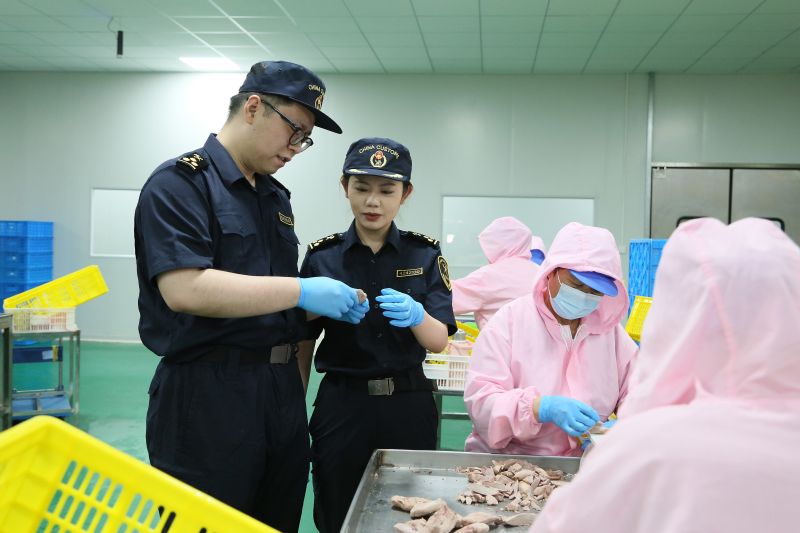
The picture shows customs officers conducting export pet food inspections. Photo by Liang Zhaohui
On June 8th, we walked into the production workshop of Linyi Hongfeng Food Co., Ltd. The automated production line was running efficiently. After strict inspection and standardized packaging, batches of pet food were about to be sent to the international market.
The company's general manager Li Xiaomin introduced that the enterprise integrates production, processing, and export. In 2015, it obtained EU export qualifications and US FDA certification. Its products are exported to countries and regions such as the United States, South Korea, the European Union, and the Middle East, and orders have been increasing year by year.
However, the road to export is not smooth sailing. The international technical trade measures for pet food are strict, and the access standards are updated rapidly. Different countries and regions have significant differences in requirements for product raw materials, food additives, microbiological safety indicators, etc. Enterprises are prone to export risks due to lagging policy information. In addition, influenced by market conditions, the prices of meat raw materials continue to rise, and the procurement costs of core pet food raw materials for enterprises have significantly increased, highlighting the pressure on production turnover and capacity expansion.
Based on the actual difficulties faced by the enterprise, Linyi Customs has established a pet food export service specialist and carried out a special assistance program of "policy door-to-door, service sinking" on a regular basis. In response to complex overseas access standards and frequently updated technical specifications, customs officers systematically sort out the differences in indicators of major export markets, guide enterprises to optimize production processes, improve raw material control, and establish product self inspection and self-control mechanisms, and build a strong export quality and safety defense line from the production source.
At the same time, Linyi Customs relies on the credit management and risk grading supervision model of import and export enterprises, scientifically optimizes the inspection and supervision process of pet food exports, achieves differentiated and precise supervision, and continuously compresses the clearance time on the basis of strictly adhering to the national security bottom line, helping enterprises seize overseas sales nodes.
Li Xiaomin stated that with precise assistance and policy support from customs this year, enterprises have effectively resolved compliance risks and cost pressures, significantly improved market competitiveness, and are expected to achieve counter trend growth in export orders for the whole year.
According to statistics, in the first five months of this year, the export value of pet food under the jurisdiction of Linyi Customs increased by 14.4% year-on-year. Small "pet food" relies on precise empowerment from customs, breaks through technical trade measures restrictions, solves development problems, and continues to sail overseas. It has become a new growth highlight for improving the quality, efficiency, expansion and upgrading of Linyi's characteristic agricultural products in foreign trade exports. (Letter from Jing Yu/Text)