
Trendy news: Cross border parcels are shipped separately and landed in Ningbo, with an expected business volume of over 100000 in the first month
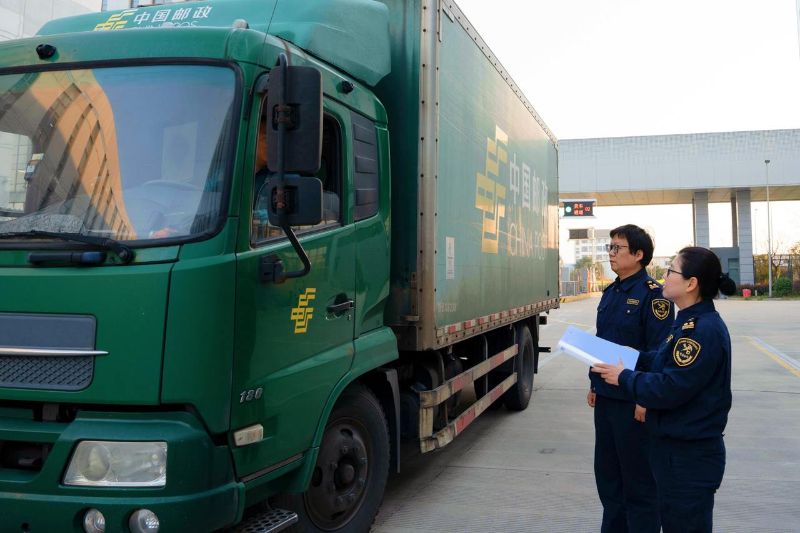
Cross border retail export packages are loaded onto trucks and shipped. Photo by Li Huan
Chao News reporter Li Hua, correspondent Xie Bailin, Li Huan, and Lu Chenze
In the warehouse of Ningbo Qingheng Network Technology Co., Ltd., staff are systematically packing packages into bags. These packages will then be transported to the Ningbo International Mail Exchange Center, and after customs supervision, they will be sent to overseas customers through postal logistics.
On March 6th, the first cross-border e-commerce retail export split order model in Zhejiang Province was launched at the Ningbo International Mail Exchange Center. As of now, 5 companies have started business with a volume of over 48000 items and a value of over 1.6 million yuan. The expected volume of business in the first month is over 100000 items.
We were established in January this year, and the order volume is not yet high. How can we quickly meet the package volume requirements for cross-border export declaration? "As a small and medium-sized e-commerce company in its early stages, Zhou Ziqi cannot help but worry. Cross border export declaration usually has certain requirements for the quantity of goods, and a small order volume means that the cost will increase. How to sell the goods abroad quickly and efficiently has become his challenge.
The problems faced by Qingheng Technology are not isolated. It is understood that by the end of 2025, the proportion of small and medium-sized cross-border e-commerce enterprises in Ningbo's online retail exports will exceed 90%.
The orders of such enterprises generally have the characteristics of 'small batch, multiple batches, and high frequency', "said Liu Jianfeng, the head of the Customs Supervision Department of Ningbo Post Office." The 'accumulation of orders' requires a high quantity threshold before it can be declared for export, which will bring problems such as slow delivery time, long inventory cycle, and high capital turnover pressure to enterprises.
To facilitate the 'going global' of enterprises, we have launched a cross-border e-commerce retail export split order model to help enterprises solve problems, "said Liu Jianfeng.
In the traditional bill of lading mode, enterprises need to transmit the bill of lading on the basis of the declaration list, and associate the declaration list with the bill of lading through the logistics bill of lading. This customs operation mode of implementing supervision based on the bill of lading is more suitable for large-scale e-commerce with bulk shipments.
In the split order mode, the customs directly implements the supervision operation mode of control, inspection, release, and clearance based on the declaration list, which is more suitable for small and medium-sized e-commerce with scattered shipments.
One package corresponds to a declaration list, and enterprises do not need to declare packages in batches, allowing small and medium-sized e-commerce companies with "daily orders and small ticket volumes" to easily reach the global market and achieve "cross-border e-commerce export with one package".
After achieving small batch shipments, small and medium-sized e-commerce can leverage the global logistics network of postal services to accelerate the expansion of emerging markets, "said Zhu Zhehong, manager of Ningbo Postal International Business Branch.