
Trendy News: 'Robot Dog' on duty, welcoming a new teammate of digitalization in the port area
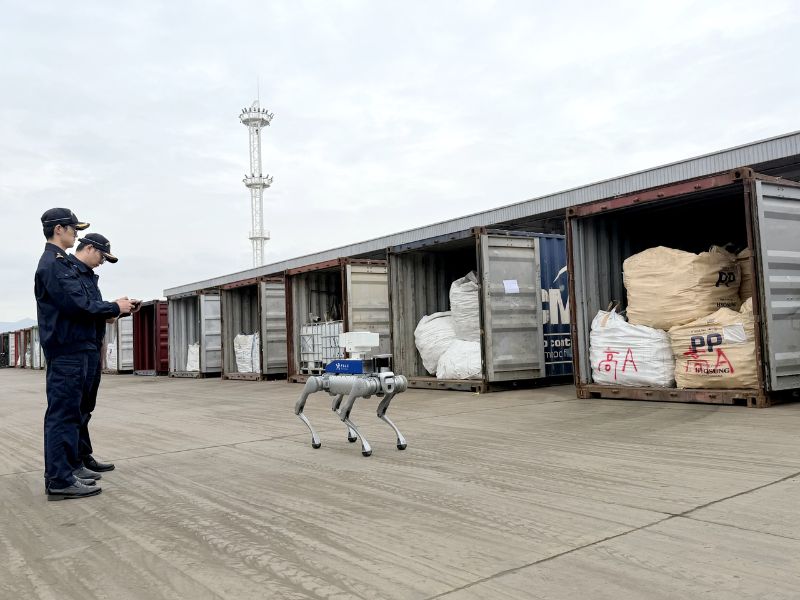
On the platform of the inspection site for Phase II of Meishan Port Area in Zhoushan Port, Ningbo, a "robotic dog" equipped with a high-definition camera is steadily inspecting along a predetermined route. It deftly shuttles between containers, occasionally stopping and casting its "gaze" towards the container body, identifying the container number and seal number, and automatically comparing it with the declared data to see if it is consistent... This is the recent operating scene of the heavy box inspection auxiliary robot developed by Meishan Customs, a subsidiary of Ningbo Customs, and also the first exploration and application of heavy box inspection auxiliary robots in ports across the country.
It is understood that Meishan Port Area is the fastest-growing single container terminal in Ningbo Zhoushan Port. In January of this year, the container throughput of Meishan Port exceeded 1.31 million TEUs, breaking the monthly throughput record of a single container terminal in Ningbo Zhoushan Port.
Along with the rapid growth of container throughput in Meishan Port Area, there has been a significant increase in the inspection business volume of Meishan Customs. To this end, Meishan Customs actively explores the inspection assistance robot project, using technological means to break through regulatory bottlenecks and improve customs clearance efficiency, and applying auxiliary robots (i.e. "robot dogs") to heavy container inspection.
According to customs officials, the heavy box inspection auxiliary robot is an intelligent equipment designed specifically for customs inspection scenarios, equipped with RTK high-precision positioning module, laser radar, angle radar perception module, and 5G communication module. Through the integration of advanced technology, robots can achieve centimeter level positioning accuracy and stably transmit data in complex environments. Its visual recognition system is based on advanced AI visual modeling algorithms, which can automatically recognize container numbers and seals. Even under poor lighting conditions, the recognition accuracy remains above 99%. At present, the inspection assistance robot has achieved functions such as assisting in opening the box door, site inspection, and accompanying supervision, significantly improving the efficiency of inspection operations and effectively preventing risks such as unauthorized entry into the site and replacement of hidden goods.
The more than 100 container berths under our jurisdiction in the past are currently operating at full capacity. In the past, manual unpacking required 4 to 6 customs officers to work for more than 1 hour. Now, with the application of inspection assistance robots, all container unpacking operations can be completed in just 20 minutes, greatly saving a lot of labor costs, "said Chen Yi, Deputy Director of Meishan Customs Inspection Department 2.
The inspection assistance robot frees customs officers from repetitive and high-intensity physical labor, allowing them to focus more on risk analysis and precise supervision. Before the application of the 'robotic dog', we need 2-3 groups of customs officers to complete the verification and confirmation of the container and seal number separately. Now, with the cooperation of the robotic dog, only one group of customs officers is needed for review, "said Zhang Wenzhi, a customs officer from Meishan Customs Inspection Department
Li Haijie, a customs declarer at Ningbo Yuhe Supply Chain Co., Ltd., has been in the industry for many years. His main job is to cooperate with customs officers to carry out cargo inspections. As a witness to the development of smart customs, he happily said, "Now that there are inspection assistance robots, the connection between customs and port operations is closer, and our cargo clearance time has been significantly shortened
The exploration and application of inspection assistance robots have brought about a 'digital intelligence' efficiency revolution, which is a beneficial attempt to combine artificial intelligence technology with customs business, "said the Chief of Meishan Customs." In the future, we will continue to explore the application of inspection assistance robots in inspection work, deeply integrate new technologies such as AI big models and multimodal analysis, achieve data sharing and intelligent scheduling, and inject new strength into the construction of smart customs