
The supply of bonded ships for oil supply and outbound shipment at Huangdao Port has increased for three consecutive years (see chart)
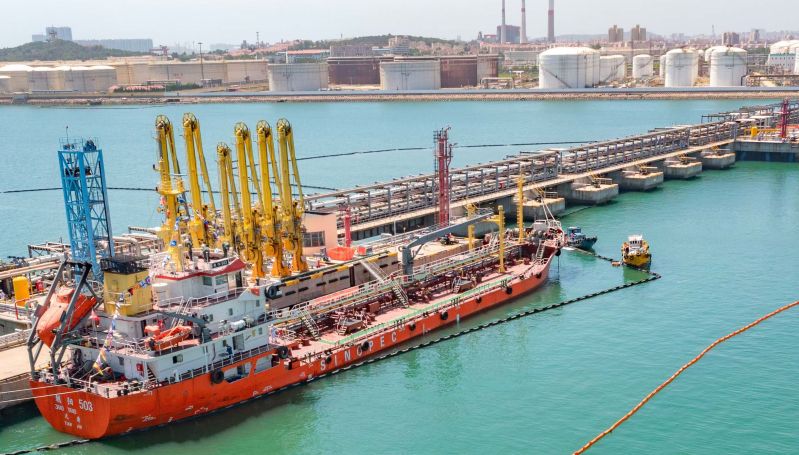
The picture shows a refueling ship berthing at the dock and refueling with ship fuel oil, photographed by Gao Yuan
The supply of bonded fuel oil is one of the core functions of international shipping centers and an important indicator for measuring the internationalization level and supporting service capabilities of ports. In recent years, Huangdao Customs, a subsidiary of Qingdao Customs, has been making efforts in the entire chain of ship fuel supply, including production, sales, transfer, and storage, and has launched a series of "bonded+" innovative measures to help Huangdao Port gradually become a bonded fuel oil storage and distribution center that radiates to surrounding ports. In 2025, Huangdao Customs supervised the release of 2.025 million tons of bonded fuel oil for ships, achieving stable growth for three consecutive years.
Recently, 27000 tons of domestically produced low sulfur fuel oil produced by Sinopec Qingdao Petrochemical Co., Ltd. were directly input into Qingdao Gangxin Oil Products Co., Ltd.'s "two warehouses" function combined with dedicated storage tanks. Through convenient account book circulation, the conversion of domestically produced oil to bonded oil can be quickly completed, and in the future, it can be directly released from the warehouse to supply international shipping vessels.
Previously, pouring tanks was not only time-consuming and labor-intensive, but also required additional storage and safety costs. Now, with a little bit of accounting, the properties of the oil have changed, and supply to the ship can be arranged on the same day, greatly improving customer satisfaction, "said Ge Defu, the business manager of Qingdao Gangxin Co., Ltd.'s public bonded warehouse.
Pouring tanks was once a necessary path for domestic fuel oil to be supplied to bonded ships. Previously, domestically produced fuel oil needed to first enter an export supervised warehouse and then be poured into a bonded warehouse before it could be used for bonded fuel supply. To solve this bottleneck problem, Huangdao Customs has innovatively launched a pilot reform of "two warehouses" function stacking, endowing pilot enterprises with the dual attributes of "bonded warehouse+export supervision warehouse", simplifying the traditional "warehouse first, then pour tank" process into a "account book direct transfer" mode, and achieving efficient conversion of domestic oil to bonded oil through list declaration without actual pouring of tanks.
"Under the new mode, the operation process is simplified from 'two in and two out' to 'one in and one out'. Taking the company's three 50000 cubic meters' two warehouse 'function plus special storage tanks as an example, the comprehensive cost savings exceed 20 million yuan, and the operation efficiency is improved by more than 30%." Wei Junying, head of the Bonded Warehouse Management Section of the Enterprise Management Office of Huangdao Customs, introduced that this mode not only significantly reduced the operating costs of the ship supply enterprises, but also improved the efficiency of the delivery of domestic fuel oil.
Shandong is an important crude oil processing base in China, with numerous ports and dense international shipping routes around Qingdao Port, making it an excellent storage center for ship fuel oil. Huangdao Customs, based on its industrial endowment and port resource advantages, actively promotes policy innovation and radiation extension. It has established a joint supervision mechanism for the direct supply of bonded fuel oil across customs zones with surrounding customs, reducing the inbound and outbound circulation of bonded oil between bonded warehouses in different customs zones, simplifying customs clearance procedures, improving fuel supply efficiency, and promoting the gradual upgrading of "local innovation" to "national standards".
Convenience measures such as' stacking of two warehouses' and 'direct supply across customs zones' have made our production capacity output smoother, and we no longer have to worry about cumbersome processes that may delay supply, "said Wang Chao, the head of Sinopec Qingdao Petrochemical Co., Ltd." By 2025, the total amount of fuel oil we will distribute from the Huangdao bonded warehouse to ports such as Zhoushan and Tianjin will exceed 1.1 million tons
Du Kai, Deputy Director of the Enterprise Management Department of Huangdao Customs, stated that in the next step, the customs will continue to focus on the core needs of enterprises, deepen the innovation of "bonded+" policies such as the combination of "two warehouses" and fuel oil blending, and help Qingdao Port accelerate the construction of an international shipping hub in Northeast Asia. (Gao Yuan, Wang Yejing/text)