
Geely invests in Ford Spain factory, creating a new model for car companies to go global
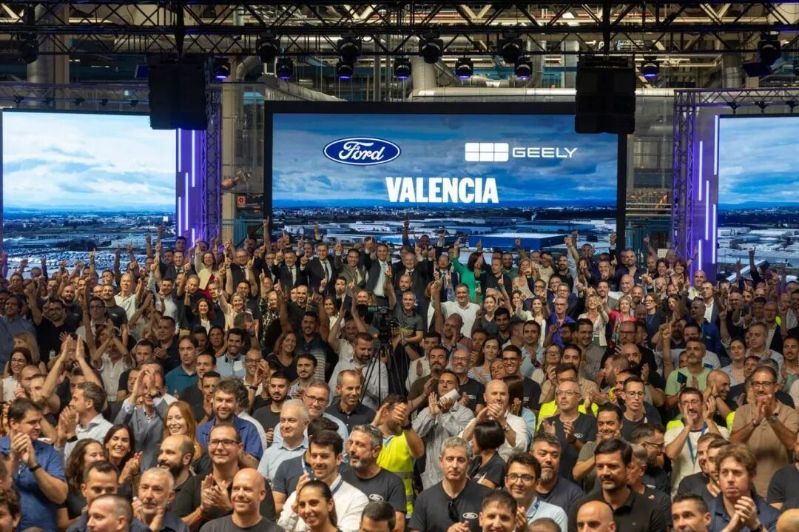
Geely Ford Valencia factory. Enterprise image supply
On July 29th, in Meishan Port Area of Zhoushan Port in Ningbo, a series of new energy vehicles were loaded onto the specialized container yard of CITIC Port through a dedicated passage. Not far away, the bridge crane on the berth of Meidong Container Terminal is steadily lifting the container loaded with cars onto the ship. Under the supervision of Meishan Customs, a subsidiary of Ningbo Customs, another batch of "Made in China" new energy vehicles is about to embark on a journey overseas.
According to statistics from Ningbo Customs, in the first half of the year, Ningbo Port exported new energy vehicles worth 25.04 billion yuan and 219000 units, an increase of 104.2% and 104.7% respectively year-on-year, with both the value and volume of exports doubling.
During the same period, the total export value of automobiles at Ningbo Port reached 30.79 billion yuan, of which new energy vehicle exports accounted for 81.3%, becoming the absolute mainstay and "green engine" of Ningbo's foreign trade exports.
During this period, the daily loading volume of the CITIC Port Connect site exceeded 400 units, with the highest daily loading volume reaching 520 units. In the first half of the year, our site's loading volume exceeded 25000 units, and the loading volume of new energy vehicles increased by nearly 200% year-on-year, "said Zhang Peng, Deputy General Manager of CITIC Port Connect.
From the perspective of export markets, the export of new energy vehicles at Ningbo Port presents a diversified pattern of "stable traditional markets and bright emerging markets".
In the first half of the year, Brazil, the European Union, and Jordan ranked among the top three in terms of export volume, with export values of 7.88 billion yuan, 4.33 billion yuan, and 2.07 billion yuan, respectively, an increase of 152.2%, 275.1%, and 166.7% year-on-year.
Among them, the performance of the UK market is particularly impressive, with exports of 1.89 billion yuan in the first half of the year, a year-on-year increase of 664%, making it one of the top five markets in terms of export value. The export value of emerging markets in the Middle East, such as Oman and Qatar, increased by 65.2 times and 14.7 times respectively year-on-year, demonstrating strong market potential.
Since the beginning of this year, the explosive growth in demand from emerging markets has given us more confidence in our new energy vehicle export business. In the first half of the year, our company's service for whole vehicle exports exceeded 50000 units, and the proportion of new energy vehicles has gradually increased, currently exceeding 50%. "said Chen Xue, the head of Ningbo Xiaohe Supply Chain Management Co., Ltd., which has long acted as an agent for Ningbo's export vehicle customs clearance business.
He told reporters that some countries that rely entirely on imported oil have a great demand for new energy vehicles, and most of these cars that have been exported are sold to the Middle East, Southeast Asia, and African countries. At present, he is actively promoting the automobile export logistics agency business to these countries.
In response to the characteristics of a large number and high frequency of automobile exports, Ningbo Customs actively promotes a "one-stop" supervision model for new energy vehicle container exports, integrating automobile loading, inspection and other processes in the same venue, greatly reducing customs clearance time.
Under the 'one-stop' regulatory mode, the processes of car packing, inspection, and shipment are all carried out at the same site, which significantly reduces the risk of quality damage during the transportation of our cars, "said Chen Xue.
After 16 years, Geely and Ford have once again teamed up heavily. Recently, Geely Automobile officially signed a contract with Ford, and its subsidiary acquired a 34% stake in Ford's Valencia plant in Spain for 221 million euros, with Ford holding 66% of the shares. The factory will become a joint venture and shared manufacturing base between the two parties, and is expected to start production in the first half of 2027. This marks a new stage for Chinese car companies to bid farewell to the single vehicle export model and enter a new stage of capacity sharing and collaborative car manufacturing when going global. The industry's battle for going global has been fully upgraded. This cooperation adopts a light asset joint venture model and is not included in Geely's consolidated financial statements. It has evolved from early brand acquisitions to capacity and technology collaboration, demonstrating Geely's mature upgrade of globalization strategy.
It is understood that after the completion of this transaction, the operating entity of the Valencia factory will be recorded as a joint venture of Geely under the equity method and will not be included in Geely's consolidated financial statements. The two parties will achieve resource complementarity through a light asset cooperation model, creating a new path of cooperation between mainstream Chinese and foreign car companies. Looking back at the origins of both parties, in 2010, Geely fully acquired Volvo Cars from Ford, setting a milestone for Chinese car companies to acquire overseas luxury brands; The re cooperation 16 years later has evolved from the previous "brand acquisition" to "capacity sharing and technology collaboration", reflecting the mature upgrade of Geely's globalization strategy.
The Valencia factory, founded in 1976, is Ford's core manufacturing base in Europe, with an annual production capacity of up to 500000 vehicles. Its technology and scale are among the top in Europe. In recent years, Ford's European market has significantly shrunk, with multiple classic models discontinued and only the Kuga production line retained. The factory's capacity utilization rate is less than 25%, and a large amount of manufacturing resources are idle. Data shows that Ford's global sales will slightly decline in 2025, falling out of the top five global car companies; However, Geely's overseas market has experienced explosive growth, with overseas sales of 474000 vehicles in the first half of 2026, surpassing the entire year of last year. As of July, sales have surged 165% year-on-year, demonstrating strong overseas momentum.
Industry data shows that Ford's global sales in 2025 will be 4.395 million vehicles, a slight decrease of 2% year-on-year, surpassing BYD for the first time and falling out of the top five global car companies in terms of sales. In sharp contrast, Geely's overseas market has experienced explosive growth, becoming one of the fastest-growing Chinese car companies. Data shows that Geely's overseas sales in the first half of 2026 reached 474000 vehicles, surpassing the annual overseas sales in 2025, with a year-on-year increase of 158%; As of July, its annual overseas sales have exceeded 580900 units, a year-on-year increase of 165%, and its overseas expansion momentum is rapid.
This cooperation has achieved a win-win situation for both parties. Ford leverages Geely to share operating costs, activate idle production capacity, and alleviate overcapacity pressure in Europe; Geely can localize production in Europe without the need to build new factories, relying on mature local supply chains and logistics systems to avoid tariff barriers and quickly establish itself in the core European market.
This joint venture company is only responsible for contract production and does not have independent research and development, sales, and brand operation permissions. After production, the factory will produce 5 models of two major brands in parallel, covering the fuel and new energy tracks. Ford will launch three multi energy vehicle models, including Kuga, a new rugged SUV, and a jointly developed crossover; Geely will produce two new energy vehicle models, including the popular Geely Galaxy Xingyuan EX2. The first new car is expected to be launched in 2028.
Ford will deploy three multi energy vehicle models, including the Kuga model that will continue to be mass-produced, the Bronco family's rugged compact SUV that will be launched in 2028, and a new crossover model designed by Ford and jointly developed by Geely. Geely will focus on developing new energy products and will launch two new new energy vehicle models, including the domestically popular Geely Galaxy Xingyuan EX2. The first model is scheduled to be officially launched in 2028.
Geely Galaxy Xingyuan focuses on the urban commuting market, with outstanding cost-effectiveness advantages, and maintains a high level of popularity in the European market, facing competitors such as Renault 5 and BYD Dolphin. After the localization and production of the vehicle, it will further enhance delivery efficiency and regional competitiveness, and solidify Geely's layout in the European new energy civilian market.
Geely has been deeply involved in the global market for many years, owning multiple well-known car brands at home and abroad, and has established more than ten overseas manufacturing bases on four continents. Europe is its global core position, and for the past 20 years, it has continuously cultivated the local market through car show layout, brand acquisition, and industrial cooperation. In May 2026, Chinese car companies surpassed Japanese brands in European sales for the first time, and Geely performed outstandingly. In the first half of the year, European sales reached 225300 units, steadily increasing year-on-year, and the penetration rate of new energy continued to increase.
Throughout Geely's development history, its growth over the past two decades has always been deeply tied to the European market. From its debut at the 2005 Frankfurt Motor Show in Germany to test the waters of the European market, to the acquisition of Volvo and Lotus sports cars, and strategic investment in Mercedes Benz Group, Geely has continued to deeply cultivate Europe through asset integration, technological cooperation, and industrial landing. In May 2026, Chinese car companies surpassed Japanese car companies in sales in 31 European countries for the first time, achieving a historic breakthrough. Among them, Geely made outstanding contributions. In the first half of this year, its European market sales reached 225300 vehicles, a year-on-year increase of 8.5%, and the penetration rate of new energy products continued to rise.
Geely stated that it will continue to deepen its localization cooperation in Europe in the future, relying on projects such as Power Technology and Lynk&Co's overseas operations to strengthen comprehensive collaboration in research and development, manufacturing, and supply chain, adhere to localized operations, and build a mutually beneficial global automotive industry ecosystem.
Affected by EU tariff barriers and localization policies, Chinese car companies are accelerating their transformation overseas, with capacity sharing and joint research and development becoming mainstream new models. The cooperation between Geely and Ford is the industry benchmark. At present, many car companies such as BYD, Chery, and SAIC have landed European production capacity projects and fully opened up overseas positioning.
Currently, leading domestic car companies are accelerating their European layout: BYD has landed a passenger car factory in Hungary, Chery has teamed up with Spain's Ebro to revitalize the former Nissan factory in Barcelona, SAIC has set up an electric vehicle base in Galicia, Spain, and Zero Run is conducting joint manufacturing with Stellantis Zaragoza factory. A group of car companies have intensively landed European production capacity projects, opening the prelude to the global positioning war of China's automotive industry.
With the acceleration of vehicle companies going global, domestic component companies are synchronously following up and laying out in Europe, forming an industrial pattern of coordinated going global for vehicles and components. This marks a new stage in which China's automotive industry has moved from exporting a single product to a systematic and large-scale industry going global.